

Understanding Redlining and Its Lasting Impact
The Greenlining Fund was created to help address the long-term effects of redlining and decades of disinvestment in Omaha neighborhoods.
While redlining was outlawed more than 50 years ago, its impacts continue to influence housing access, wealth-building opportunities, neighborhood investment, and homeownership rates today. Understanding this history helps explain why intentional reinvestment remains necessary.
What Was Redlining?
Redlining was the practice of denying mortgages, loans, insurance, and other financial services to neighborhoods based largely on the race, ethnicity, or income level of the people who lived there.
Beginning in the 1930s, federal housing agencies and private lenders used color-coded maps to rate neighborhoods according to perceived lending risk. Communities with Black residents, immigrant populations, or lower-income households were frequently marked in red and labeled "hazardous" for investment.
As a result, families living in these neighborhoods often could not access conventional home loans, regardless of their financial qualifications. The consequences extended far beyond housing. Redlining limited opportunities for homeownership, restricted wealth creation, discouraged private investment, and reinforced patterns of segregation that still shape communities today.
Redlining Across the United States
During the Great Depression, the federal government created programs intended to stabilize the housing market and expand homeownership.
In 1934, the Federal Housing Administration (FHA) began insuring mortgages, making homeownership more accessible for millions of Americans. However, many of these programs excluded communities of color through discriminatory lending practices and underwriting standards.
Government-sponsored maps identified neighborhoods based on perceived lending risk. Areas with Black residents were routinely classified as undesirable, making it difficult or impossible for families to secure mortgage financing.
Although the Fair Housing Act of 1968 made housing discrimination illegal, generations of families had already been denied opportunities to build wealth through homeownership.
Redlining in Omaha
In 1935, the Home Owners' Loan Corporation (HOLC) created a residential security map of Omaha that categorized neighborhoods into four investment grades:
Green — "Best"
Neighborhoods considered low-risk and highly desirable for investment.
Blue — "Still Desirable"
Areas viewed favorably but with slightly higher perceived risk.
Yellow — "Definitely Declining"
Neighborhoods considered less desirable and often targeted for reduced investment.
Red — "Hazardous"
Areas where lenders were discouraged from making loans. These neighborhoods were frequently home to Black residents, immigrant communities, and working-class families.
Because banks and lenders relied on these classifications, residents in red and yellow neighborhoods often faced significant barriers to obtaining mortgages, home improvement loans, and other forms of credit.
This systematic disinvestment contributed to lower homeownership rates, aging housing stock, fewer economic opportunities, and reduced neighborhood investment.
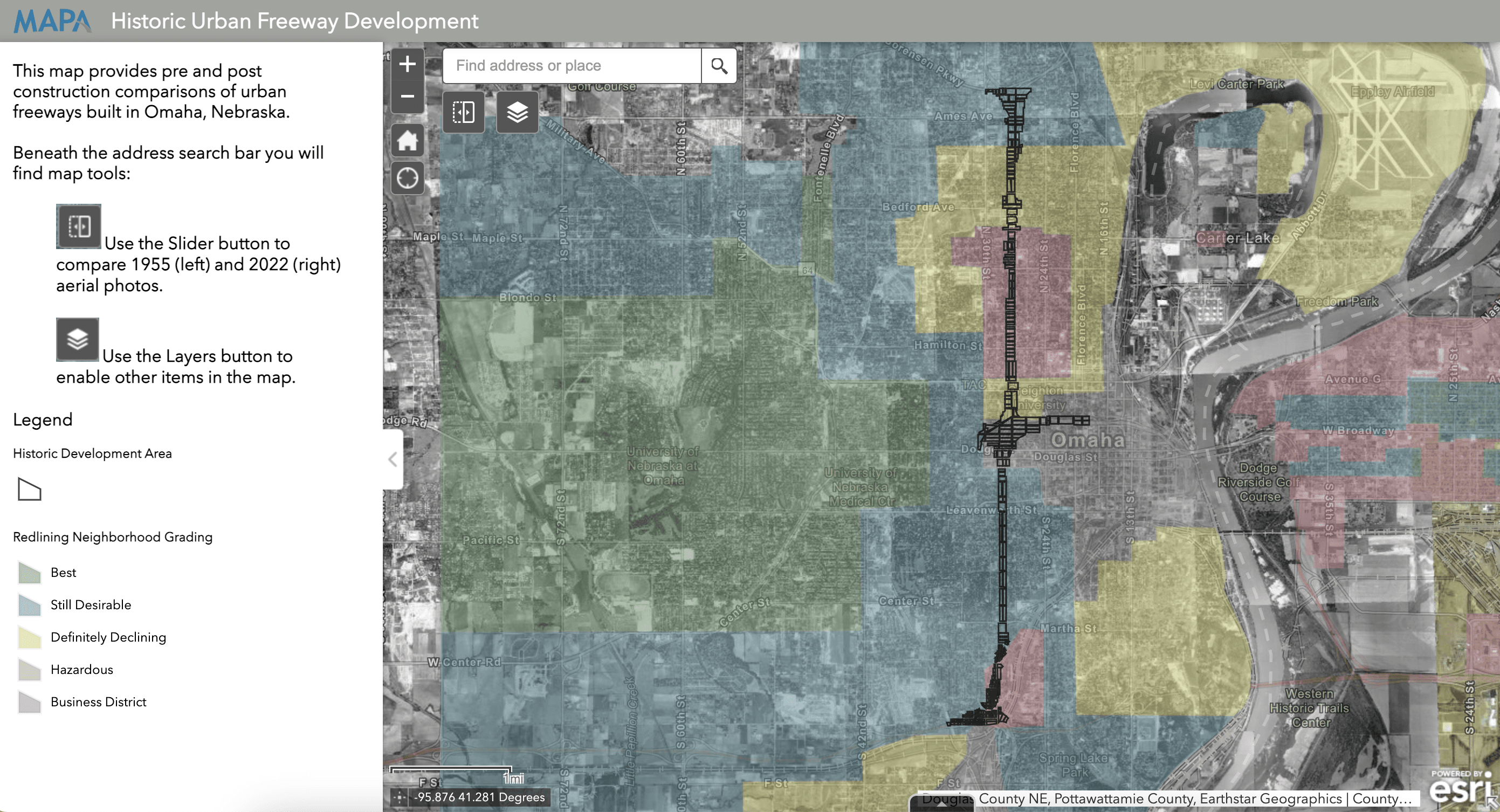
To look up the address of a property, and determine if it is located in a formerly redlined area, use the lookup tool. Enter the address in the search bar. Green indicates areas formerly identified as "best", blue indicates areas formerly identified as "still desirable", yellow indicates areas formerly identified as "definitely declining" and red indicates areas formerly identified as "hazardous."
